日期:2026/08/30 IAE
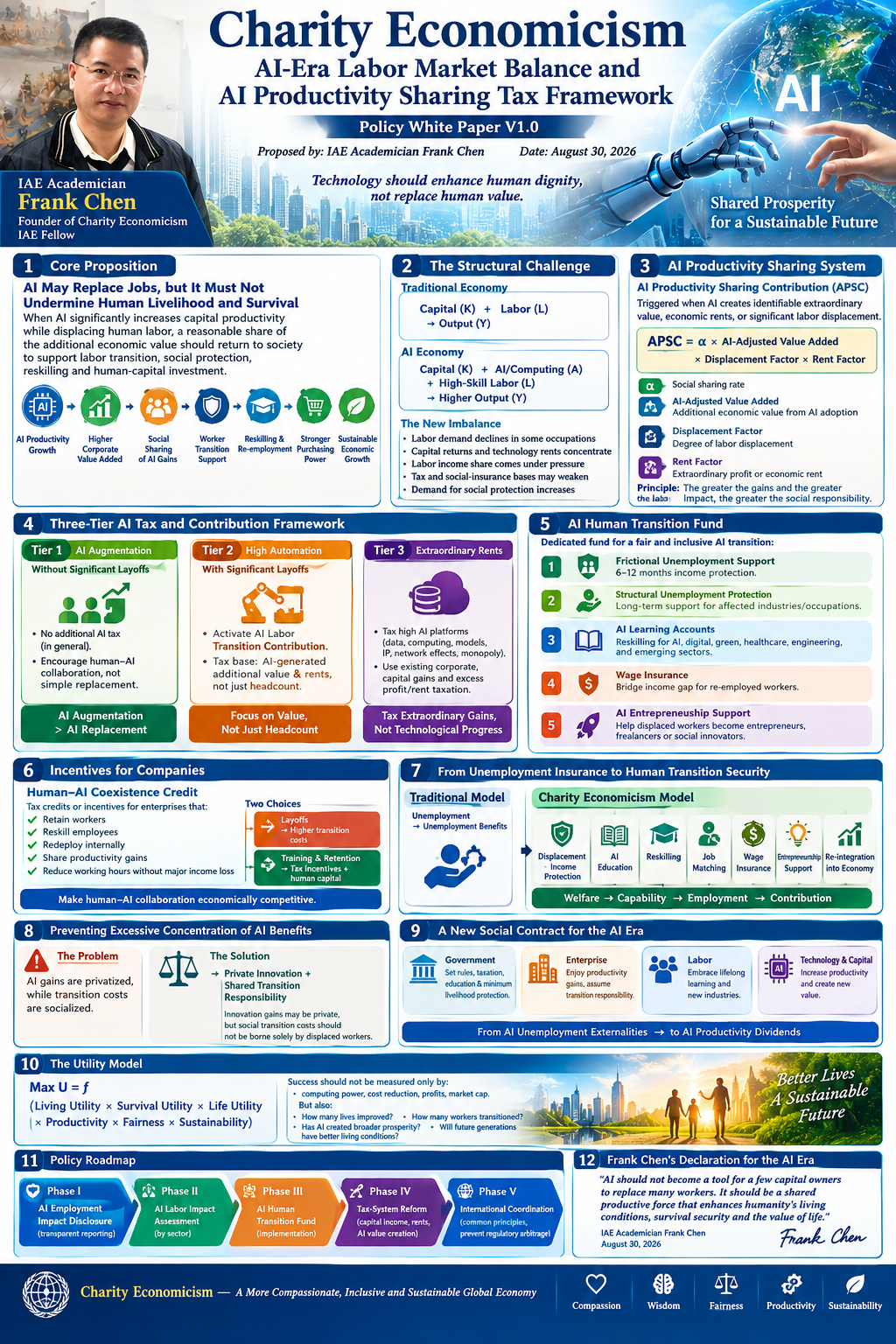
Charity Economicism: AI-Era Labor Market Balance and AI Productivity Sharing Tax Framework
Policy White Paper V1.0
Proposed by: IAE Academician Frank Chen
Date: August 30, 2026
1. Core Proposition: AI May Replace Jobs, but It Must Not Undermine Human Livelihood and Survival
Charity Economicism proposes a new principle of economic governance for the AI era:
When AI significantly increases capital productivity while displacing human labor, a reasonable share of the additional economic value generated by AI should be returned to society to support labor transition, social protection, reskilling, and human-capital investment.
The objective is not to oppose AI or prevent enterprises from automating. Instead, it is to establish a positive economic cycle:
AI Productivity Growth → Higher Corporate Value Added → Social Sharing of AI Gains → Worker Transition Support → Reskilling & Re-employment → Stronger Purchasing Power → Sustainable Economic Growth
2. The Structural Challenge of the AI Economy
The traditional industrial economy can be expressed as:
Capital (K) + Labor (L) → Output (Y)
The emerging AI economy increasingly becomes:
Capital (K) + AI/Computing Power (A) + Smaller Amounts of High-Skill Labor (L) → Higher Output (Y)
This transformation may create a new distributional imbalance:
AI Productivity ↑
→ Labor Demand Falls in Certain Occupations
→ Capital Returns and Technology Rents Become Concentrated
→ Labor Income Share Comes Under Pressure
→ Income-Tax and Social-Insurance Bases May Weaken
→ Demand for Social Protection Increases
The central policy question is therefore:
How can society preserve innovation incentives while ensuring that the benefits and transition costs of AI are distributed fairly?
3. Frank Chen's Proposed “AI Productivity Sharing System”
Rather than adopting a simplistic:
“One AI system or one robot = one fixed tax”
Charity Economicism proposes an:
AI Productivity Sharing Contribution — APSC
Enterprises should make an additional social-transition contribution primarily when AI produces identifiable extraordinary value, economic rents, or substantial labor displacement.
A conceptual framework can be expressed as:
APSC = α × AI-Adjusted Value Added × Displacement Factor × Rent Factor
Where:
α — Social Sharing Rate
AI-Adjusted Value Added — Additional economic value reasonably attributable to AI adoption
Displacement Factor — Degree of labor displacement
Rent Factor — Extraordinary profit or economic rent generated through AI
The principle is:
The greater the extraordinary gains generated by AI and the greater the measurable labor-transition impact, the greater the corresponding social-transition responsibility.
4. A Three-Tier AI Tax and Contribution Framework
Tier I — AI Augmentation Without Significant Layoffs
Where AI primarily assists employees and improves productivity without significant workforce reduction:
No additional AI displacement contribution should normally apply.
Public policy should encourage:
AI Augmentation — Human + AI Collaboration
rather than indiscriminate:
AI Replacement — AI Substitution for Human Labor
Tier II — High AI Automation with Significant Labor Displacement
Where an enterprise introduces AI, significantly increases productivity, substantially reduces employment, and realizes increased profits, an:
AI Labor Transition Contribution
could be activated.
Its tax base should primarily reflect AI-generated additional value and economic rents, rather than simply penalizing companies according to the number of workers laid off.
Tier III — Extraordinary AI Economic Rents
Large AI platforms may generate exceptional economic rents because of their control over:
Data × Computing Power × Foundation Models × Intellectual Property × Network Effects × Market Concentration
Governments may therefore strengthen taxation of capital income, extraordinary profits, or economic rents through appropriately designed existing tax systems.
The principle should be:
Tax extraordinary economic gains—not technological progress itself.
5. Establish an “AI Human Transition Fund”
Revenues generated through the new framework should be transparently allocated to a dedicated:
AI Human Transition Fund
The fund could support five major programs:
1. Frictional Unemployment Support — Temporary income protection, potentially for 6–12 months depending on national circumstances, while workers search for new employment.
2. Structural Unemployment Protection — Longer-term assistance for workers whose entire occupations or industries undergo structural AI transformation.
3. Individual AI Learning Accounts — Dedicated funding for reskilling in AI, digital technologies, green industries, healthcare, engineering, and emerging service sectors.
4. Wage Insurance — Temporary support for displaced workers who accept new employment at substantially lower wages, reducing the economic risk of occupational transition.
5. AI Entrepreneurship and Microenterprise Support — Helping displaced workers become AI-enabled entrepreneurs, independent professionals, social entrepreneurs, or one-person enterprises.
6. Reward Companies That Protect Workers
Charity Economicism should not rely solely on taxation. It should also provide positive incentives.
A:
Human–AI Coexistence Credit
could provide tax credits or other incentives to enterprises that adopt AI while:
retaining workers, retraining employees, redeploying workers internally, sharing productivity gains, or reducing working hours without disproportionately reducing income.
This creates two economic choices:
Layoffs → Greater Transition Responsibility
or
Worker Reskilling → Tax Incentives + Retention of Human Capital
The goal is to make human–AI collaboration economically competitive with simple labor replacement.
7. From Unemployment Insurance to Human Transition Security
The traditional model is:
Unemployment → Unemployment Benefits
The Charity Economicism model expands this into:
Job Displacement → Income Protection → AI Education → Reskilling → Job Matching → Wage Insurance → Entrepreneurship Support → Economic Reintegration
This transforms welfare from passive assistance into a capability-building system:
Welfare → Capability → Employment → Contribution
8. Preventing Excessive Concentration of AI Benefits
The objective is not to oppose capital owners or entrepreneurs.
Capital must receive reasonable returns, and innovators must retain strong incentives to create new technologies.
The systemic problem arises when:
AI productivity gains are privatized while AI transition costs are socialized.
Enterprises may capture AI-generated profits while workers, families, communities, and governments absorb the costs of:
unemployment, retraining, income losses, social assistance, and regional economic disruption.
Charity Economicism therefore proposes:
Private Innovation + Shared Transition Responsibility
Innovation gains may legitimately generate private wealth, but the social costs created by large-scale technological transition should not be borne exclusively by displaced workers.
9. A New Social Contract for the AI Era
The framework requires cooperation among four major actors:
Government — Establish taxation, regulation, education systems, and minimum livelihood protection.
Enterprise — Enjoy AI productivity gains while assuming reasonable transition responsibilities.
Labor — Participate in lifelong learning and adapt to emerging industries.
Technology & Capital — Increase overall economic productivity and create new forms of value.
The objective is to transform:
AI Unemployment Externalities
into:
AI Productivity Dividends
shared across society.
10. Charity Economicism’s AI-Era Utility Model
Traditional corporate economics often focuses on:
Max Profit
Charity Economicism proposes a broader objective:
Max U = f
(Living Utility × Survival Utility × Life Utility × Productivity × Fairness × Sustainability)
The success of AI should therefore not be measured solely by:
computing power, cost reduction, corporate profits, or market capitalization.
It should also ask:
How many people's lives have improved?
How many displaced workers successfully completed economic transition?
Has AI productivity been transformed into broader social prosperity?
Will future generations enjoy better conditions for livelihood, survival, and human development?
11. Policy Roadmap
Phase I — AI Employment Impact Disclosure
Large enterprises disclose AI investment, occupational changes, workforce reductions, retraining, and productivity effects.
↓
Phase II — AI Labor Impact Assessment
Develop sector-specific AI labor-impact assessment mechanisms.
↓
Phase III — AI Human Transition Fund
Establish dedicated mechanisms for income protection, education, reskilling, and employment transition.
↓
Phase IV — Tax-System Reform
Reduce excessive dependence on labor taxation while improving the effective taxation of capital income, extraordinary economic rents, and AI-era value creation.
↓
Phase V — International Coordination
Develop common international principles to reduce regulatory arbitrage and prevent AI capital from simply relocating to jurisdictions with the weakest transition responsibilities.
12. Frank Chen’s Charity Economicism Declaration for the AI Era
AI should not become merely a tool through which a small number of capital owners replace large numbers of workers. It should become a shared productive force that improves humanity’s living conditions, survival security, and value of life.
Technological progress should not be punished. Instead, institutions should ensure that a reasonable portion of the additional value created by technological progress supports those who bear the costs of economic transition.
Therefore, the goal of Charity Economicism is not:
“Stop AI from replacing jobs.”
It is:
“When AI replaces certain forms of work, humanity must still share in the civilization dividend created by AI.”
This represents a transition from:
Capital vs. Labor
toward:
Capital × AI × Labor × Humanity
and establishes a new economic equilibrium for the AI era based on:
Compassion × Wisdom × Fairness × Productivity × Sustainability
IAE Academician Frank Chen
August 30, 2026